Why Thai Restaurants Lose Guests Before Service Even Starts
Your Digital Storefront Is Your Most Important Location: Why Thai Restaurants Win or Lose Guests Before Service Even Starts
How a broken Google listing or outdated menu costs you ฿40,000 a month—and why your "real" restaurant isn't the one with tables and chairs
Restaurant Digital Storefront Thailand: The Invisible Location That Decides Everything
Let me ask you something that might sting: When did you last update your opening hours on Google?
Not your Facebook page. Not your Instagram bio. Your Google Business Profile—the thing that pops up when someone types "[Your Restaurant Name] Bangkok" into their phone.
If you're like most Thai restaurant operators, you set it up once, maybe during COVID, and haven't touched it since. Meanwhile, that profile has been showing you're "Open" on Mondays when you've been closed for a year. It's displaying a menu from 2022 with prices 30% lower than today. And the photos? Three blurry shots of dishes you don't even serve anymore.
Here's the gut punch: That broken digital storefront just cost you a table of four. They searched, saw conflicting info, and went to the competitor down the street who keeps their Google profile updated.
Most restaurant operators think their storefront is the physical space—the neon sign, the host stand, the kitchen pass. But today, your most important location is digital. And it's usually the one you manage least.
What "Digital Storefront" Actually Means (Hint: It's Not Your Website)
Before a guest ever walks through your door, they've already interacted with your restaurant across multiple touchpoints. According to Google's local search behavior data, 76% of people who search for something nearby on their smartphone visit a business within a day. But here's what they do first:
- Check if you're actually open (not what Google guesses)
- Scan your menu for prices and availability
- Look at photos to judge food quality and vibe
- Read recent reviews for red flags
- See if they can order directly or need to call
They've already decided whether to visit—before your food quality or service has any chance to matter.
Your digital storefront isn't your website. It's the entire ecosystem that answers one question for the guest: Can I trust this place right now?
That ecosystem includes:
- Google Business Profile (Search + Maps) — where 64% of local discovery happens
- Delivery and pickup listings — the apps where 70% of Thai consumers now discover new restaurants
- Menu visibility and accuracy — pricing, modifiers, availability
- Photos, hours, status updates — the visual proof that you're active and professional
- Direct ordering capability — can they book or order without friction?
This isn't marketing. It's pre-service operations. And most Thai restaurants are failing at it.
Digital Storefront Failures: The Silent Revenue Killer
The problem isn't dramatic. It's subtle—and that's what makes it dangerous.
Common failure points in Thailand's F&B market:
Incorrect hours and holiday schedules — You closed for Songkran but Google says you're open. A family drives 30 minutes, finds locked doors, leaves a 1-star review. That review sits there, unanswered, scaring off future guests.
Menu mismatches — Your GrabFood listing shows tom yum goong at ฿180, but in-store it's ฿220. The customer feels scammed. Or worse: they order via your website, show up, and you've run out of prawns. No one updated inventory.
Outdated photos — Your Google profile shows the old interior from before the renovation. Guests arrive expecting cozy booth seating and find plastic stools. The disconnect creates immediate disappointment.
Broken ordering flows — Your "Order Online" button goes to a dead page. Your LINE OA auto-reply sends a menu PDF from 2021. The customer gives up and orders from the competitor with working tech.
Each issue alone seems minor. Together, they quietly reduce conversion by 30-40%. According to BrightLocal's local consumer review survey, 94% of consumers say a negative review has convinced them to avoid a business—and many of those reviews stem from digital storefront failures, not actual service.
The agony? Guests who hesitate don't complain. They don't call to say "your hours were wrong." They don't DM you about the broken link. They just... move on. To the restaurant next door. To the chain with better digital hygiene. To the new opening that just launched with perfect listings.
Restaurant Operations vs Marketing: Why This Is a Systems Problem
Storefront accuracy fails for one reason: fragmentation.
Your hours live in your POS system (maybe). Your menu lives in another. GrabFood, LINE MAN, ShopeeFood, Robinhood—each requires manual updates. Your Google profile is a separate login you forgot the password to. Your website was built by a freelancer who disappeared.
No one owns the storefront end-to-end. So updates lag behind reality. When you run out of sea bass, it takes three days to remove it from every platform. When you raise prices for inflation, half your listings still show old rates. When you launch a lunch set, no one posts it to Wongnai.
This fragmentation becomes expensive when ecommerce enters the mix. According to TechCrunch's analysis of delivery app economics, restaurants lose 25-30% of revenue to commissions—but they lose another 10-15% to operational failures: refunds for unavailable items, bad reviews from unmet expectations, support overhead from confused customers.
These aren't branding issues. They're operational ones. And they're bleeding you dry.
Digital Storefront Management Checklist: Accuracy Beats Perfection
Strong digital storefronts follow a simple discipline: Accuracy beats perfection.
You don't need professional food photography (though it helps). You need consistency. At minimum:
Hours & status always current — Update Google, Facebook, and all delivery apps the moment you change. Use posting features to show "Open for lunch service" or "Closed for private event."
Menus synced across platforms — Same prices everywhere. Same availability. If you're out of something, it's removed within the hour, not the week.
Ordering flows that work — Every button tested weekly. Every payment method functional. No "Call to order" when you could have "Click to order."
Reliable, predictable fulfillment — If you offer 30-minute delivery, you hit 30 minutes. If you promise "available for pickup," it's ready when they arrive.
Restaurants that treat their storefront like a living system—not a setup task—convert more traffic without spending more on ads. According to Google's economic impact data, businesses that verify and actively manage their Google information are twice as likely to be considered reputable by consumers.
What to Fix First (Order Matters)
If you're prioritizing improvements, focus in this sequence:
1. Hours & status — Trust starts here
Wrong hours destroy trust instantly. Right hours build confidence. Update Google Business Profile, Facebook, and all delivery platforms simultaneously. Post status updates for holidays, special events, or temporary closures.
2. Menu accuracy — Pricing, availability, modifiers
Audit every platform. Same prices. Same items. Real-time availability. If you can't fulfill it, don't list it. The cost of a refund and bad review exceeds the lost sale.
3. Ordering experience — Delivery, pickup, payment flow
Test every path monthly. Website booking. LINE OA ordering. App checkout. Fix broken links. Simplify confusing flows. Add "Reserve" and "Order" buttons to your Google profile (this alone can increase conversion 40%).
4. Photos & presentation
Replace blurry images. Add context—interior shots, busy dining scenes, food being prepared. Show current reality, not aspirational fantasy.
5. Reviews & feedback loops
Respond to every review within 24 hours. Good or bad. Thank the positive. Address the negative publicly, fix privately. This signals active management.
Everything else—SEO, social media campaigns, influencer partnerships—builds on these fundamentals. A broken storefront amplifies bad reviews. A solid one converts casual browsers into committed guests.
Digital Storefront Optimization: The Final Truth
Your digital storefront is already representing your restaurant—accurately or not.
The restaurants winning in Bangkok's saturated market aren't necessarily louder or more expensive. They're clearer, more consistent, and easier to trust. When a potential guest searches "Thai restaurant open now" at 8:47 PM on a Friday, the winner is whoever shows up with correct hours, recent photos, a working booking link, and a menu that matches reality.
The loser? Whoever has a 2022 holiday schedule still posted, a broken website link, and a "Call for reservation" when the line is busy.
You don't need to outspend the competition. You need to out-system them.
Either audit your digital storefront manually this weekend—every platform, every listing, every link—or use a system that syncs it all automatically. But stop ignoring your most visited location. It's not the one with the fancy interior design.
It's the one that shows up when someone types "hungry" into their phone.
Your digital storefront is already working. Make sure it's working for you.
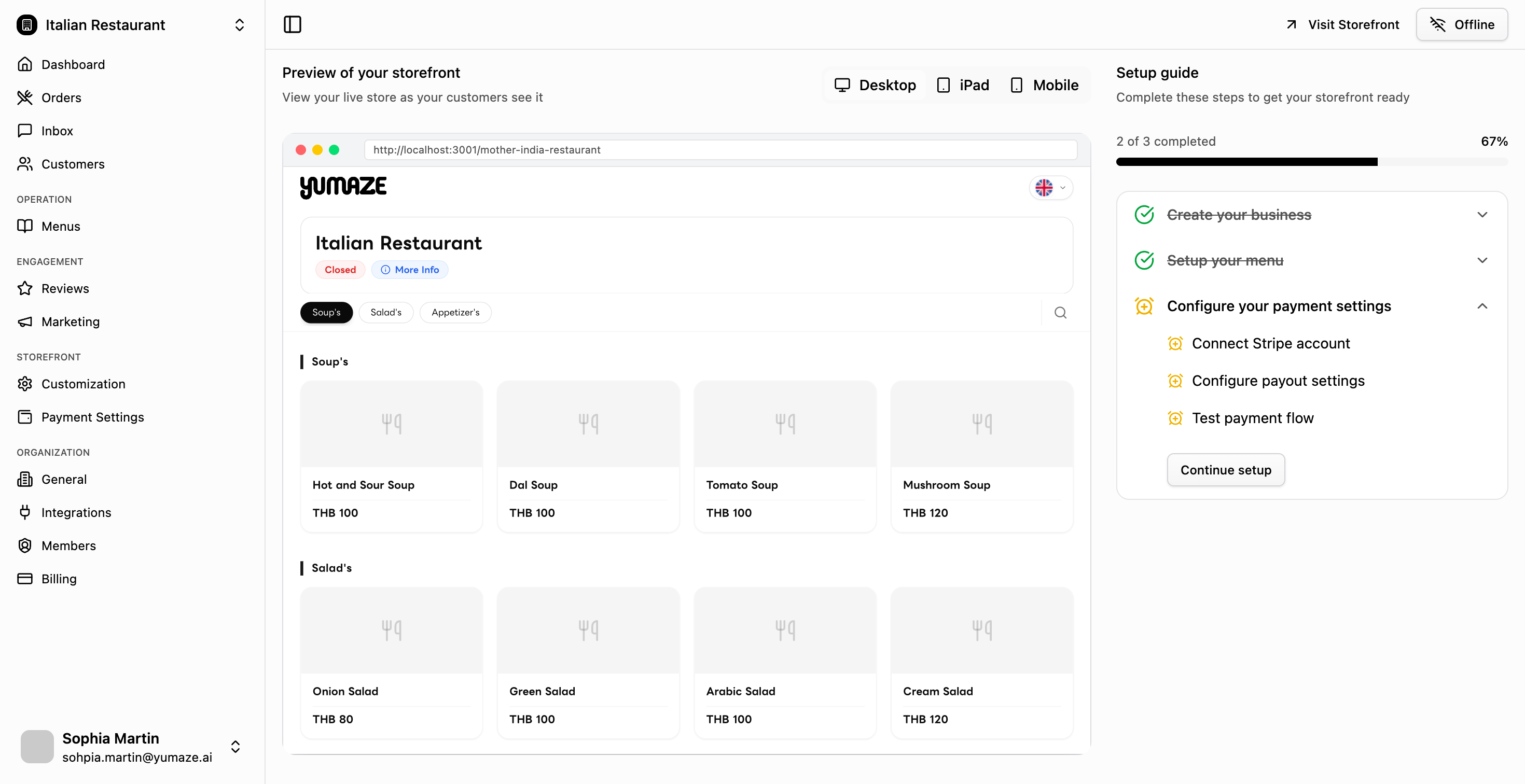
Ready to stop losing guests to broken listings? See how Yumaze syncs your hours, menus, and ordering across Google, delivery apps, and your direct channels—or grab a coffee and audit your Google profile right now. Just don't wait until your competitor's "Open" sign (digital and physical) steals your next table.
Yumaze Team
Author
Table of Contents
How a broken Google listing or outdated menu costs you ฿40,000 a month—and why your "real" restaurant isn't the one with tables and chairs
Date
2026-02-09
Category
Operations
Tags
Share